

It’s been a while since I posted on this blog. Nothing particularly interesting has happened since my last NMAT attempt in 2023. My test performances in 2024 were fairly below expectations, often marred by silly mistakes. I ended up not appearing for CET 2024 because I was occupied with something else. The best test of 2024 turned out to be CUET-PG, one of the easiest exams I’ve ever seen. I scored 295 out of 300 (74 correct out of 75)—the maximum score for that particular paper. Though multiple students had the same score, only one name was mentioned in the official document, following some undisclosed logic (which they didn’t reveal, even after I emailed them).
But I digress. Let’s get back to the 2024-2025 test season. I didn’t write about my NMAT attempt, breaking a ritual I had started a long time ago. Not out of reluctance, but because there wasn’t much to say—it was practically the same test as before. The purpose of writing one’s experience is to offer insights into preparation and the test-taking process. My 278 wasn’t bad, but quite a few people managed to beat it this time.
CAT 2024 was a disaster—I fell below the 99th percentile for the first time in a long while. Surprised? I’m not. I know exactly what contributed to that abysmal performance. MICAT went as usual, and though it doesn’t provide ranks (which it should, or at least a percentile), my score of 29 in Slot 1 seemed competitive. SNAP was another close call—just a few more correct answers would have done it for me, but I had to settle for a 99.93 percentile. Not bad, but I know I’m capable of better. That’s the frustrating part of taking these tests—even at this age and stage, when my performance doesn’t matter anymore, it still stings when I fall short.
CMAT 2025
That brings us to the one test I had the least expectations from—CMAT. My scores in previous years have been wildly inconsistent. In one year, I scored a 100 percentile in the Innovation & Entrepreneurship (I&E) section, and in another, I had an overall 99.97 percentile with AIR 17. But barring those exceptional years, my attempts have been largely forgettable, with AIRs slipping beyond the top 100.
The structure of CMAT is tricky. The heavy emphasis (20% weightage each) on GK and I&E makes it a test where knowledge outweighs speed, problem-solving, or question selection—the skills that define most aptitude tests. If you’re good at GK, you can beat a lot of candidates because, unlike Quant or Verbal, where preparation levels are intense, GK is acquired over time and requires a different approach. You can’t cram for it as you do for other sections.
I&E, in contrast, isn’t very difficult. With some common sense and preparation, anyone can improve. At IMS, we ran a YouTube series of eight sessions on I&E, supplemented by reading materials available on myIMS, with ten chapters covering essential concepts. This should have helped students significantly. Personally, I’ve never prepared for I&E specifically, and I never will, for two reasons: (1) I’ve already done an MBA, where much of this theory was covered, and (2) I cleared the NET in Management, which required thorough preparation in this area. That prior knowledge allows me to perform well in this section without any targeted effort.
Test Day Chaos
Now, let’s talk about the actual test-day experience. When I found out I was scheduled for the second slot, I was a bit annoyed. I rarely get Saturdays free, so I wanted the test to be done in the first half. I was following the analysis of Slot 1, paying attention to what IMS mentors and the Acads team had to say. The consensus? The test was on the easier side. That only added to my frustration—I’ve always maintained that aptitude tests should be difficult to create meaningful segregation.
Since I wasn’t particularly invested in CMAT, I did a last-minute hall ticket printing and thumb impression exercise—something that serious aspirants should never do, as it increases stress levels. I reached the venue at exactly 2:29 PM—one minute before they shut the gates. Close call!
The usual scanning, lab location, and system allocation process followed. A few students recognized me, which has started happening more frequently in every test. But unlike other tests, I didn’t get a chance to talk to anyone. My system was in the extreme corner, with a wall to my right and an absent candidate’s seat to my left—the perfect distraction-free setting.
After 15 minutes of waiting through instructions, the test finally began.
The Test Attempt
Even in the past, I’ve maintained a fixed order to complete Round 1 of my attempt in CMAT: start with Quant, jump to LR (my second favorite section), then VARC, followed by I&E, and keep the GK section for the end. Then, go through all the sections again in the same order for Round 2.
Quant
I started with Quant. The Slot 1 review was still running through my head, but Slot 2’s Quant section turned out to be lengthy. An easy question, in my opinion, is one that’s direct and solvable in three to five steps. Except for a handful of such questions, most were lengthy. Luckily, CMAT allows ample time, so I took my time, spending nearly 50 minutes on 18 questions. I skipped a couple of Probability and P&C questions, keeping them for Round 2. When I came back to these questions later, I was able to solve them.
This time, unlike previous attempts, I maintained proper rough work for all questions, which allowed me to cross-check my answers. (A tip from my end to all the future aspirants.) I was confident I had gotten them all correct, though such confidence hasn’t always yielded positive results to me in the past. But overall, I was happy with the attempt.
LR
Next, I moved to LR. Puzzles, coding-decoding, and series were all standard. Except for Critical Reasoning—my weak spot—I solved everything confidently. With CR, I sometimes take half-chances because of the risk-reward trade-off. Most of the questions were done with ease. I kept a few CR questions for Round 2 and double-checked some answers to ensure decent accuracy.
VARC
VARC and I have a complicated relationship. Sometimes, everything falls into place, and sometimes, it doesn’t. RCs, vocab, and parajumbles were easy. However, my weakness—technical grammar—was tested. I learned grammar intuitively through reading and listening, so I answer based on the feel of the language rather than rigid rules. Every year, I tell myself to formally learn grammar, and every year, I don’t. I had 18 solid attempts in VARC, so I took a gamble on the rest.
I&E and GK
For I&E, my past preparation and the effort put into creating the YouTube series came in handy. I was sure of at least 15 correct answers. Management and Innovation questions can sometimes be ambiguous, but I attempted all of them, expecting to score 60+.
Then came GK—my nemesis. I was confident about ten questions. The big decision: should I take a chance on the remaining ten? If all went wrong, I’d drop to 30. But if even two were right, I’d get 40. I took the risk and marked all of them.
By the end of the test, I had attempted all the questions as usual. But this time, I was more confident in my attempts, estimating my score above 300.
Post-Test Analysis and the Long Wait
I rushed out immediately after the test to avoid the crowd and head back for our live analysis on YouTube. I had a quick chat with the Acads team about good attempts, difficulty levels, and question distribution. This routine is part of the post-test process. After reaching home, a strong coffee was all I needed to gear up for the live analysis. You can watch it here.
When the answer key was released a week later, I checked my responses past midnight. The breakdown was: Quant: 80, LR: 70, VARC: 70, I&E: 70, and GK: 45. CMAT always has answer key discrepancies, and this year was no different—one question had two identical options. We decided to challenge five questions from Slot 2. After thorough analysis, the Academics team did not find anything objectionable in the Slot 1 answer key, and therefore, no challenges were made for that slot.
I was thrilled with my 80 in Quant. A total of 335 is a strong score, but without knowing the candidate pool, it’s hard to judge if 335 is worthy of being at the top. Based on early score data, Slot 1 candidates performed better than Slot 2, indicating a slightly easier test. From then on, it was just a long wait for results.
Final Results
When the results arrived yesterday, I got a 99.99 percentile with AIR 8 and a perfect 100 percentile in Quant. My personal best was all I had hoped for after the test, and I was content to see it on screen.
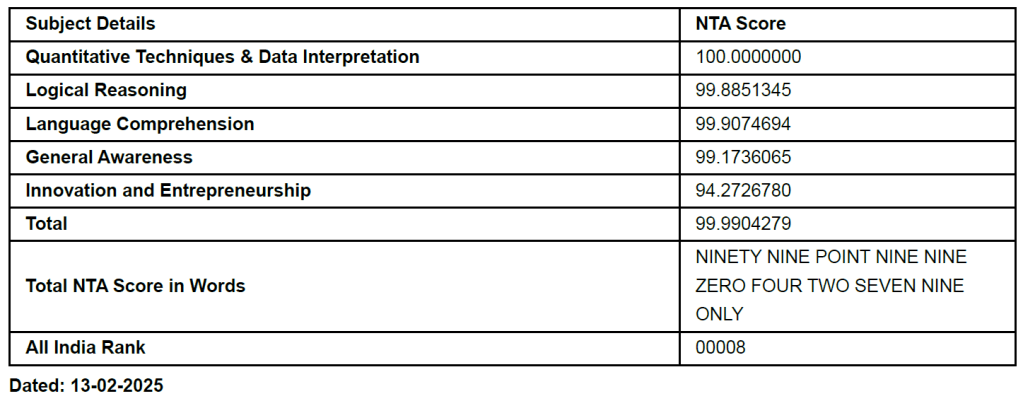
Is it just me, or do the percentiles in I&E and GK look swapped? With a 70/80 raw score in I&E and 45/80 in GK (before the answer key challenge), the percentile seems a bit off.
My advice to aspirants: work on GK and make it a strong area. But don’t ignore core aptitude areas because that’s where the bulk of your score will come from. If you’re aiming for the top, strong GK is essential.
I hope this post has given you some insights into CMAT test taking strategy. Let me know if you have any queries. Happy prepping! 🙂
 Cracking MBA CET
Hi Prasad Sir ! Please guide us through the last month of CET preparation !!
LikeLike
Pingback: Close, But Not 99.99 – Cracking MBA CET