

Dear students! I hope all of you are doing well and that the CET 2025 result hasn’t disappointed you too much. I had planned for a more positive post and I wrote it in bits and pieces over the last few days, thinking of a solid high performance. The result has changed the mood a bit. Some of you may wonder, how does that even matter? And I’m with you on that. My performance shouldn’t matter! But for regular readers of this blog, and for those who understand the elite test-taker (if I can call myself that) mentality, this post will resonate.
I walked into CET 2025 with hardly any expectations. With the kind of negative publicity the test has received over the years, keeping very high expectations is likely to lead to disappointment. So, my objective was to just do whatever possible, leave the test venue as soon as I could, and come up with a good analysis for our students. Regular readers of this blog also know that the best performance of the year was CMAT 99.99, which I’ve covered in depth here. It was definitely a confidence booster! But CMAT and CET are completely different, and a strong performance in one doesn’t necessarily translate to a similar performance in the other.
I had a familiar test venue where I’ve appeared for several tests in the past. The most irritating part was that the testing lab was on the 4th floor, and they made all the students walk. We were prohibited from using the lift. The scrutiny at the test venue was substandard. The biometric verification happened outside the test lab, and then we were assigned a lab. We were also asked to remove our footwear outside the lab (another thing that absolutely irks me). Inside the lab, one had the freedom to sit wherever they wanted. In fact, I sat at a particular machine and found the chair to be wobbly, so I shifted to the empty machine on my right. There was also a wall clock in front of me, which was useful in two ways: one, it allowed me to time a bio break before the test instructions, and two, during the test, I could look at it to get a sense of how I was doing. Not saying the on-screen timer isn’t great. It’s just that I’m old school, and an analog watch feels far more comfortable. Anyway. So, while I was still wondering how carelessly the whole thing had been arranged, it was time to start the test.
My strategy as demonstrated in the live solving and mentioned multiple times in my sessions has been to start with AR, then move to either VA or QA, and finally tackle LR as the last section. Within a section, I take rounds in solving: tackling the easy ones first, then moving to the difficult ones. This approach allows me, and anyone who follows it, to gain a solid base score, and the subsequent rounds ensure that you add extra marks. There was also the thought of the test being jumbled, but since they haven’t done that in quite some time, it felt like a far-fetched possibility. A sectional paper, honestly speaking, is a student-friendly format and allows one to play according to one’s strengths. The slightly changed test interface this time took a bit of getting used to: the question panel appeared on the left-hand side, unlike all other tests where it appears on the right. But it wasn’t a big concern.
Abstract Reasoning: I was able to handle most of the questions in the first look itself, but there were several counting-based questions which I left for the second round. These questions need careful counting, and I didn’t want to spend too much time on them. There was also a question type I hadn’t seen earlier (except in the Atal mock provided by CET Cell) involving 9 images and grouping them into 3 groups of 3 images. But it was pretty straightforward to understand. With 20+ attempts, I think I had done reasonably well in the first 20 minutes of the test, and I moved on to the Quant section.
Quantitative Aptitude: My strongest suit in CET has always been Quant. I started confidently, knocking off most of the direct questions. There were several lengthy ones which I skipped, planning to handle them in the second round. I was certain of my accuracy, and there were only 2–3 questions where I took random half-chances because they were too lengthy to solve. I realized I was lagging a bit in speed, and it took me nearly 55 minutes to solve all the questions but I was happy with the attempt. I moved to Verbal Ability after this.
Verbal Ability: This was a standard CET affair. The surprise this year was the passages! Some of them short, some lengthy. For a few, a single reading was enough, while others required a second read. The rest of the VA section wasn’t very challenging, but I did take half-chances on some of the grammar and vocab-based questions. Generally, my goal for the VA section is to get a score of at least 35 and consider anything above that a bonus. While solving, I felt it was possible to get closer to 40. AsI was going fast, I was bound to make a few errors but 50 attempts with 80% accuracy, translating to a score of 40, was decent enough for me. I wrapped up the section in about 30 minutes and moved on.
Logical Reasoning: The final section. I had just about 45 minutes left and 75 questions remaining. I kinda kicked myself for spending more time than planned on QA (at least 10 extra minutes), but it was okay. I just prayed for a moderate paper and thankfully, it turned out to be that way. I skipped almost all the caselet-based questions and focused on the standalone ones to get the base in place. I pushed for as many attempts as possible in the caselets, randomly marking some of the questions.
Towards the end, I had hit nearly 185 genuine attempts and randomly marked around 15 questions. I don’t have the exact count, but this seems like a fair estimate. If I hadn’t spent the time that I did in Quant, I could’ve definitely managed a few more genuine attempts in the Logical Reasoning section.
After the CET Cell released the response sheet and objection tracking, it became evident that there were multiple errors across all the slots. IMS challenged all the questions worth challenging, in the hope that CET Cell would act on them. But on 19th May, when the CET Cell released the outcome, it became clear that they had conveniently retained some of the glaring errors in the answer key as they were. Anyway, there was no point in complaining after that. My overall score went up by 3 marks. This is how I performed on the test:
| Section | Based on the answer key | After objection outcome | Accuracy |
| Abstract Reasoning | 21/25 | 22/25 | 88% |
| Logical Reasoning | 57/75 | 58/75 | 77% |
| Quantitative Aptitude | 47/50 | 48/50 | 96% |
| Verbal Ability | 39/50 | 39/50 | 78% |
| Total | 164/200 | 167/200 | 84% |
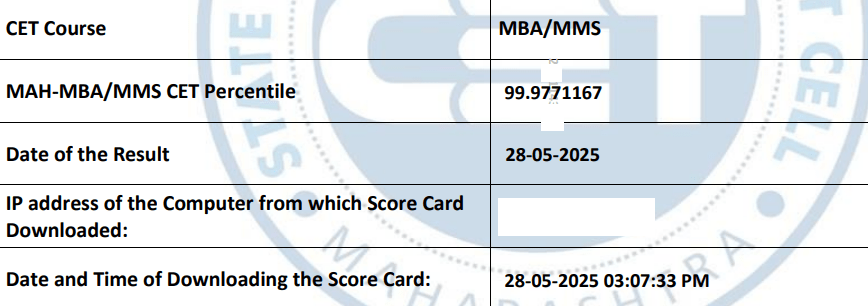
The final announcement of the result happened today. I was hoping to get my personal best percentile, but unfortunately, it didn’t happen. A 99.97 isn’t bad! That’s what most people will say, especially when it’s coming from absolutely zero preparation and just one mock attempt. But that’s not the point. In my mind, this will continue to remain an underperformance. 99.99 remained elusive! Could have happened, but didn’t!
I hope this post offers takeaways for students that they can implement in their test preparation and strategy. Hopefully, I’ll post more on the blog going forward. I’ve been meaning to do this for a long time but have never really gotten around to. See you soon!
 Cracking MBA CET